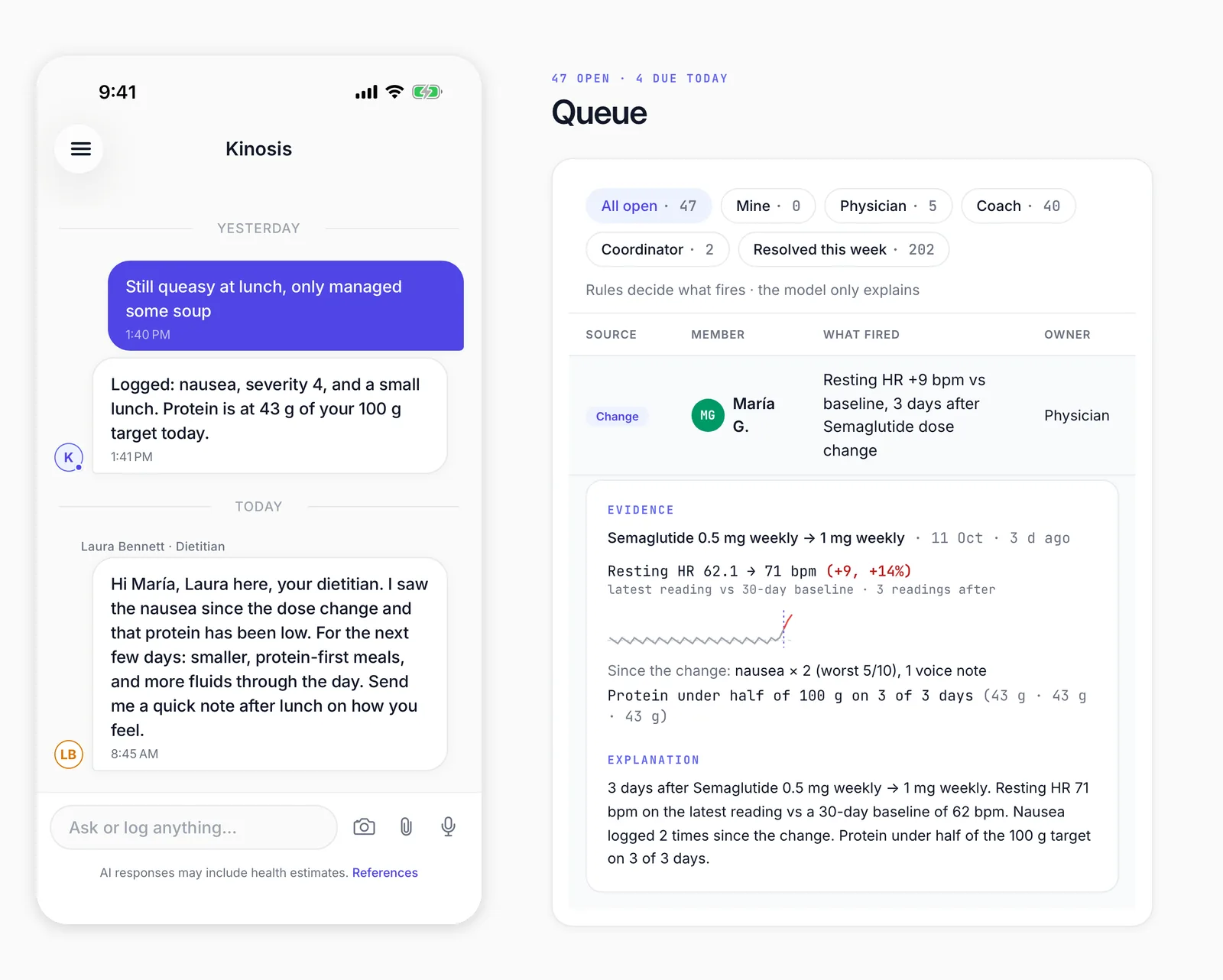
At 7:40 a.m., María’s watch syncs her night. Three days after her GLP-1 dose went up, her resting heart rate is nine beats above her baseline, she has logged nausea twice, and she has eaten less than half of her protein target. A signal appears in her provider’s care queue. Before 9 a.m., the program’s dietitian has seen it and sent a reply: smaller, protein-first meals, more fluids, and a quick note after lunch on how she feels. The message lands in María’s own chat, signed by the dietitian. She never had to call, and nobody had to go looking.
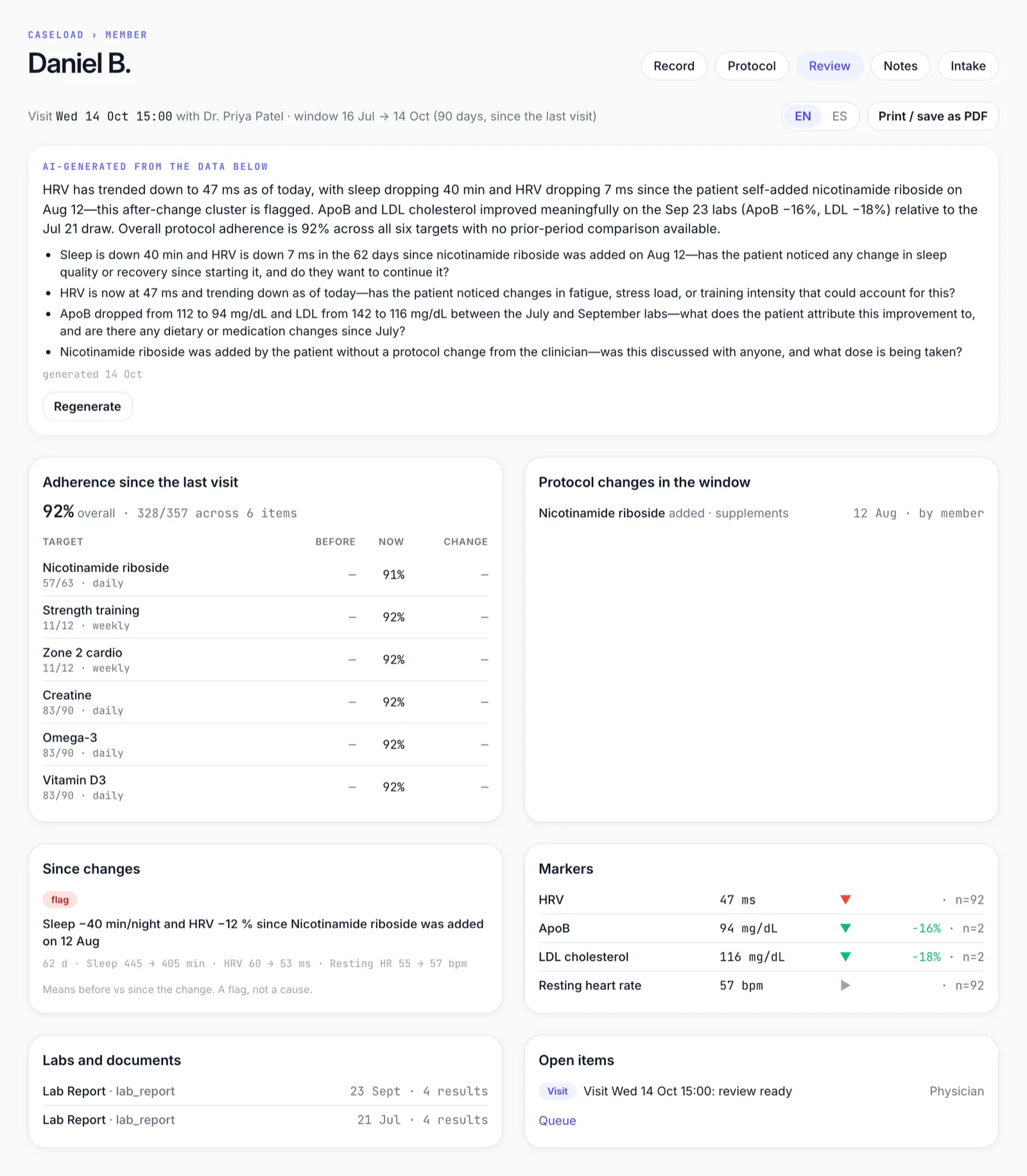
That afternoon, Dr. Patel opens the pre-visit brief for a 3 p.m. patient six months into a longevity protocol. Adherence is 92%. LDL is down 18%. But the brief flags the one thing that has not moved the right way: since a new evening supplement was added in August, sleep has dropped by 40 minutes a night, and HRV has followed. Instead of spending the first twenty minutes reconstructing the last quarter, the visit starts there.
This is what an AI-enabled health practice can look like: not a chatbot operating outside the care team, but an intelligence layer that turns everyday patient activity into structured information, highlights what matters, and helps clinicians act sooner.
Kinosis is the health protocol intelligence layer: it connects the patient app, WhatsApp, wearables, lab reports, protocols, adherence, efficacy, messaging, visits, and the Providers Portal in one workflow. It runs the protocol between visits while existing systems continue to hold the chart, scheduling, billing, insurance, and prescribing records.
From a voice message to a live patient record
Patients should not have to become data-entry clerks to participate in their own care.
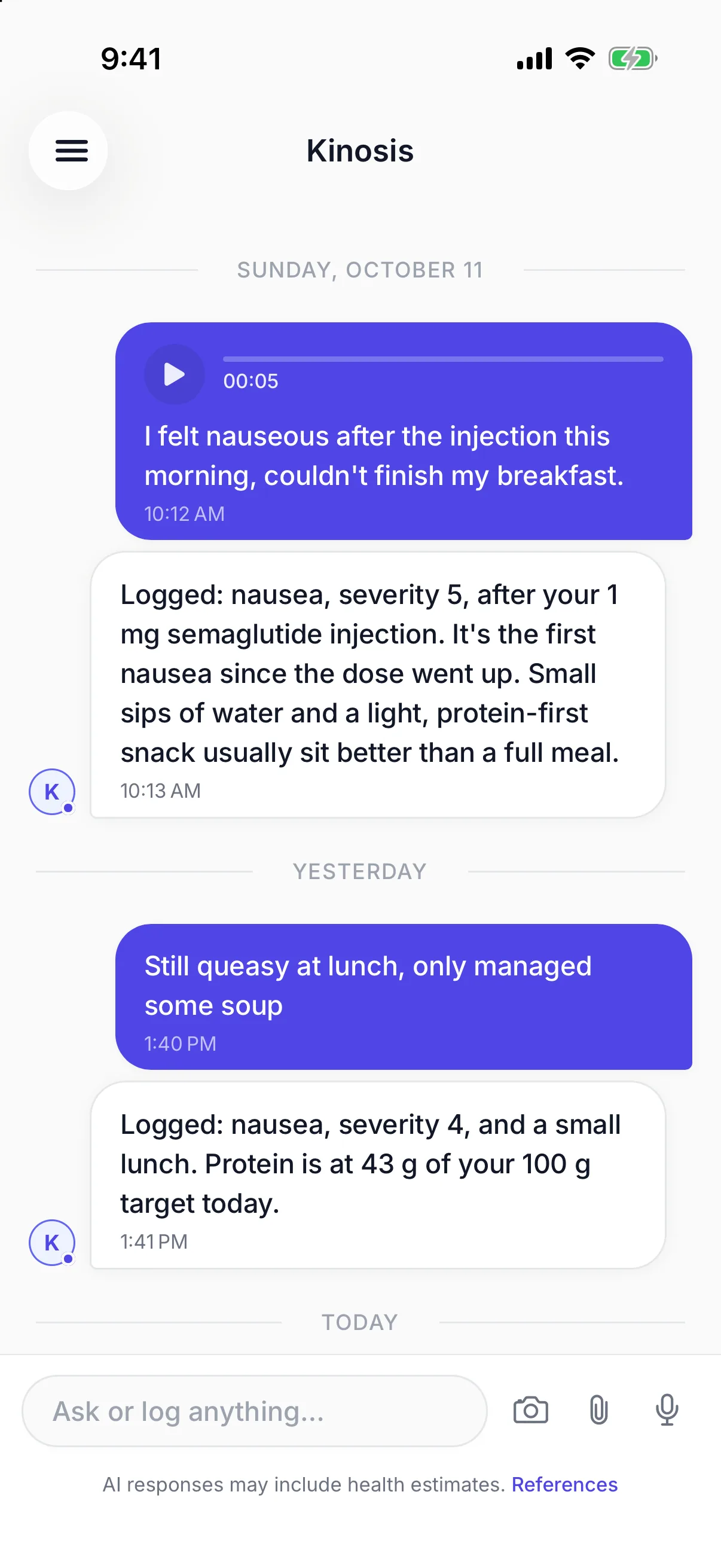
A patient can write or speak naturally, send a photo, or use a one-tap reminder. They can log through the Kinosis app or WhatsApp, with no forms and nothing new to learn. Data can also arrive through Siri, Apple Watch, ChatGPT, Claude, connected wearables, and uploaded lab reports. Kinosis turns these inputs into structured health events in the patient’s record.
“I did my knee exercises, but my pain was a 3 out of 10” can become adherence, activity, and symptom data. A meal photo can become an estimated nutrition record. A voice note about nausea after an injection can become a structured side-effect event. A lab PDF can become a dated set of markers that can be compared over time.
The platform connects behavior, biology, context, and experience across nutrition, sleep, activity, mood, symptoms, biometrics, medications, supplements, laboratory results, life events, and environment. For providers, that means less reconstruction from memory and more visibility into how the patient is actually following the plan.
See whether the protocol is being followed—and whether it is working
Kinosis turns a provider’s instructions into a live protocol with targets, schedules, reminders, required items, phases, and one-tap confirmations. The team can see adherence to each protocol item rather than relying on a patient’s general recollection at the next appointment.
The same record also separates adherence from efficacy. Adherence shows what the patient did. Efficacy looks at whether the relevant markers are moving. The platform presents efficacy by marker instead of hiding different measures inside one opaque composite score.
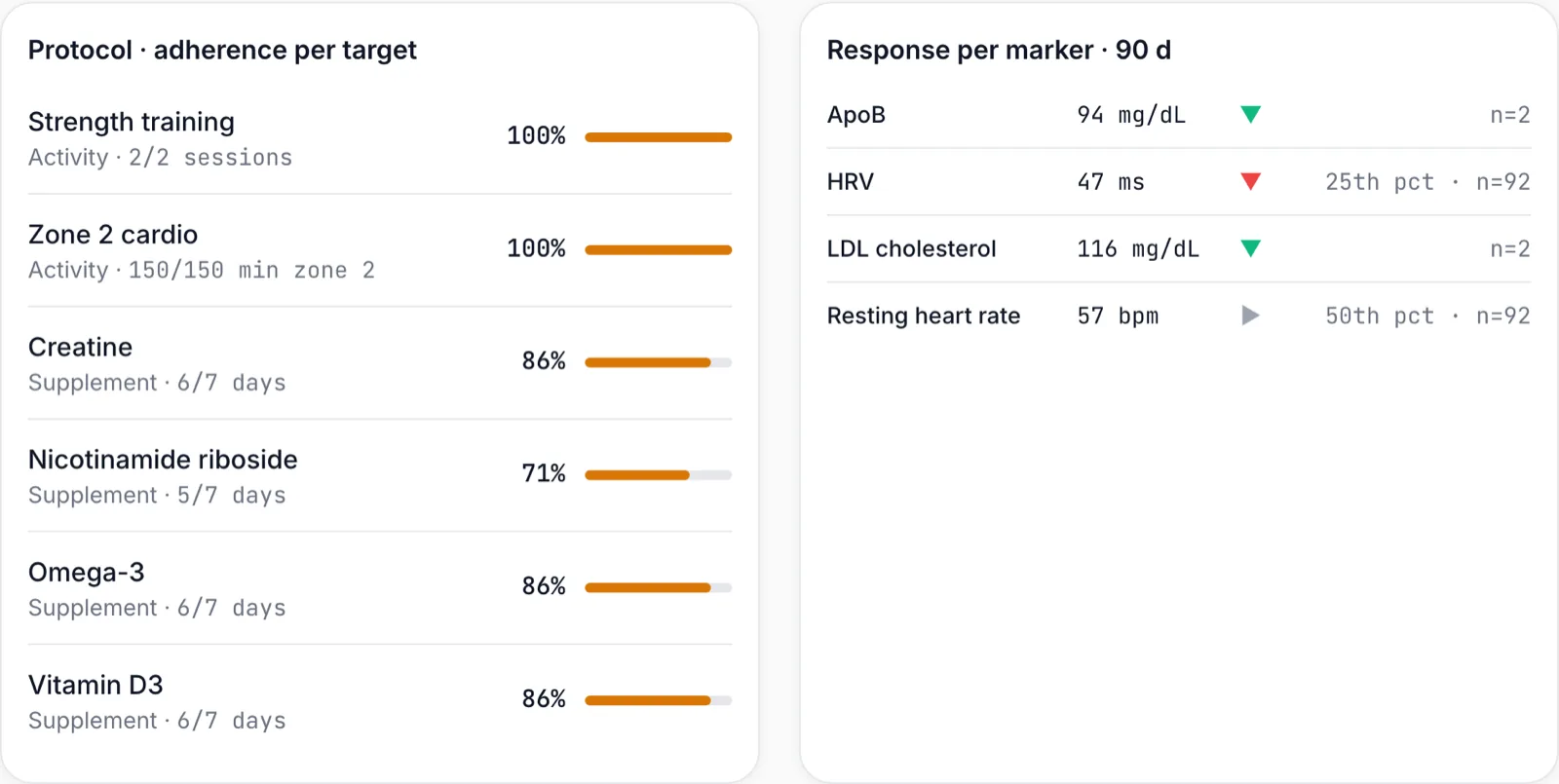
A metabolic program may follow glucose, HbA1c, weight, body composition, and blood pressure. A performance program may follow VO₂ max, heart-rate recovery, HRV, and recovery trends. A chronic-disease program may follow symptom frequency, symptom severity, and inflammatory markers. Wearable data, manual logs, and laboratory reports can feed the same longitudinal view.
That distinction makes the next clinical conversation more precise. If a marker has not improved, the provider can ask whether the protocol was followed consistently, whether the intervention was insufficient, or whether another factor may be affecting the result. The correlation engine points to possible reasons in the patient’s own data. The provider remains the decision-maker; the intelligence layer makes the question easier to find.
A care queue that prioritizes evidence, not inbox order
More patient data is useful only if the team can act on it. Kinosis turns the longitudinal record into a queue of who needs attention today.
The queue can prioritize patients who are missing required items, slipping in adherence, showing a marker that is not responding, reporting a symptom pattern, failing to answer check-ins, or going quiet. Team members can work inside the patient’s existing conversation, rather than forcing every issue into a separate workflow.
This is one of the most practical forms of clinical intelligence. It does not ask a physician to monitor every patient equally or search through every message manually. It helps the practice direct limited human attention toward the patients most likely to benefit from timely contact.
A copilot for intake, visits, and patient questions
Kinosis also reduces the administrative work around care delivery.
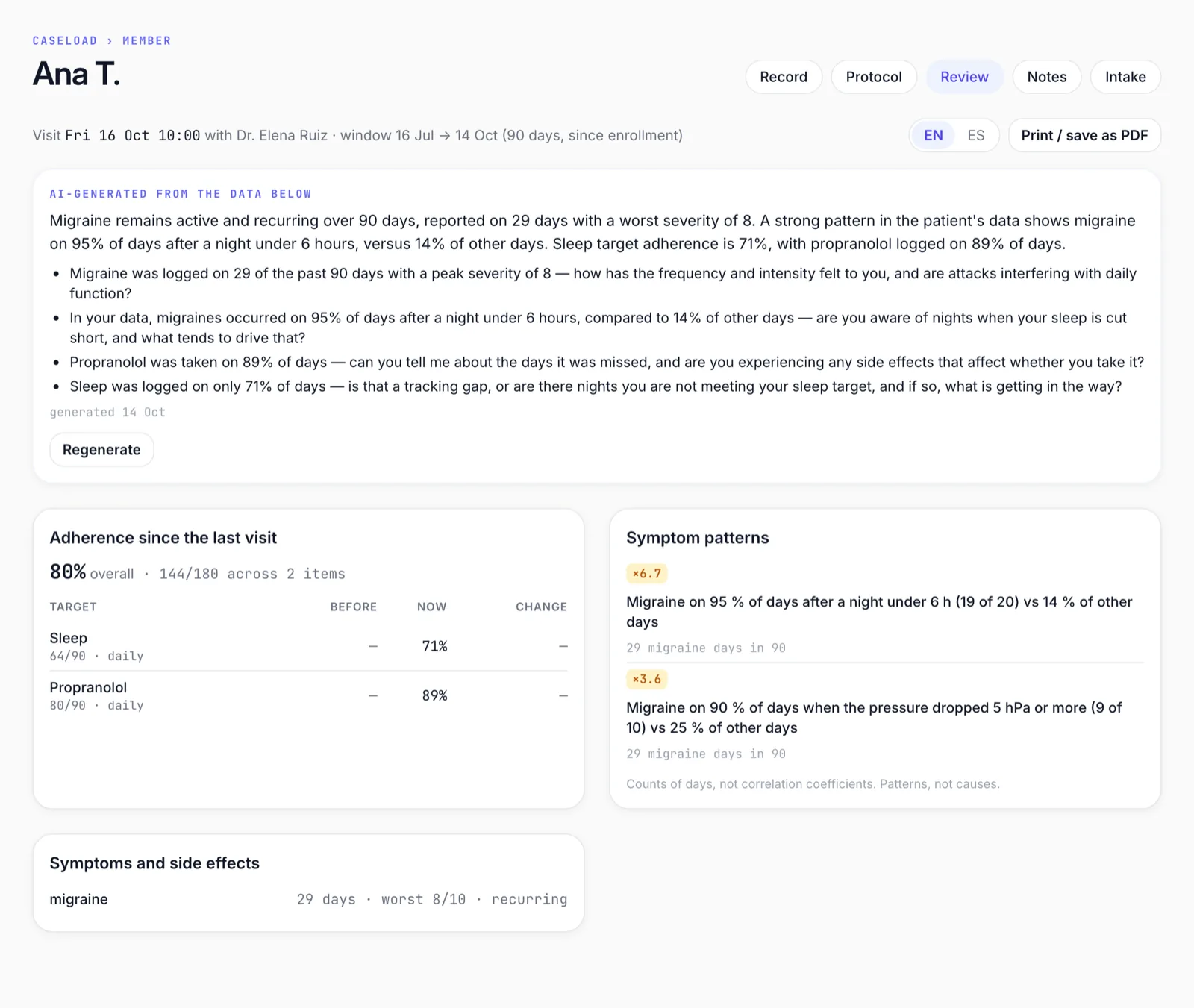
Providers can create their own intake questionnaires, pre-visit reviews, ongoing check-ins, and branching screening flows. Before a visit, the system can assemble what changed since the last appointment, adherence by protocol item, marker trends, patient answers, and talking points. Afterward, a provider can dictate a note and review drafts of the visit note, patient summary, and protocol changes before anything is sent or adopted.
Providers can also upload their own aftercare instructions, procedure guides, nutrition rules, and FAQs. When a patient asks a question, the answer can come from those materials with the source named. If the question falls outside the provider’s guidance, it can go to the team instead of receiving an unsupported answer.
Providers can ask questions of their caseload in plain language. For example: which post-op patients have not done their exercises in three days? The result is a patient list with the data behind it, turning a natural-language question into a starting point for review.
The trust point is in how summaries are produced. Code computes the figures, while AI writes the sentences. Every number is checked against the data it came from, and a summary that fails the check is not shown. AI-generated summaries are labelled and presented alongside their supporting data.
Kinosis does not diagnose or prescribe. It captures, organizes, summarizes, and drafts; clinicians decide.
What this looks like in practice
Consider a patient living with migraine. Instead of arriving at the next appointment trying to remember how many attacks there were and what came before them, the patient logs each attack, its severity, and the medication taken, along with sleep, caffeine, meals, stress, and menstrual cycle, through the app or WhatsApp. Wearable data joins the same record, and Kinosis adds the local weather, including barometric pressure, every day without the patient doing anything.
The care team can then see whether attacks are becoming more or less frequent, whether the preventive medication is being taken as prescribed, and whether the acute medication is being used too often. Over a few months, the Kinosis correlation engine finds patterns the patient never reported: attacks clustering after short nights, or on days when the pressure drops. A pre-visit summary puts those patterns in front of the clinician, while the queue can surface the patient earlier if attacks start to increase.
The same model works for physiotherapy. Exercises become protocol items. Pain and function become longitudinal outcomes. Missed sessions become visible. The therapist can spend more of the visit on progression and problem-solving instead of trying to reconstruct the previous weeks.
Fits the way practices already work
Kinosis works alongside tools such as Healthie, Practice Better, Cerbo, and Elation. The Providers Portal supports physicians, coaches, and coordinators with role-based access and patient consent. Larger programs can use a branded patient app, connect Kinosis to their systems, or add the intelligence layer inside an existing app through integrations, APIs, webhooks, and exports.
The app is free for patients. They can also use WhatsApp with nothing to download. Plans start at $99 per month for a solo practice and include a 14-day trial. The app and portal support English and Spanish, and patients can write or speak in any language.
The larger shift is from episodic, memory-based follow-up to continuous, protocol-aware care. Every patient interaction can become part of a usable longitudinal record. Every protocol can be reviewed against adherence and outcomes. Every team member can see who needs attention and why.
For providers ready to make that shift, start at kinosis.ai/providers.